Korniche Roof Lantern U-Value: 1.2 W/m²K Explained
The Korniche roof lantern uses 28mm argon-filled double-glazed units with a glass U-value of 1.2 W/m²K on the Clear, Neutral and Blue glass, or 1.0 W/m²K on the Premium range. That is a strong glass specification for an aluminium roof lantern. For homeowners specifying a roof lantern over a kitchen extension or open-plan living space, the U-value matters because the rooflight is one of the largest single sources of heat loss in the room. When comparing quotes, ask for both the glass-unit and the whole-rooflight U-value, because suppliers publish different figures.
This guide explains what these U-value numbers actually mean in practice, how Korniche compares to other rooflights, and when to choose the Premium glass range.
What U-Value Measures
U-value is the rate at which heat passes through a building element, measured in watts per square metre per degree Kelvin (W/m²K). Lower is better. A U-value of 1.2 means that one watt of heat is lost per square metre per degree of temperature difference between inside and outside.
In England, Approved Document L sets a maximum U-value of 2.2 W/m²K for new and replacement rooflights. That limit applies to the whole rooflight; Korniche publishes its U-value for the glass unit, which makes up most of the lantern's area.
For context, common building elements:
- Solid wall (uninsulated): ~2.0 W/m²K
- Single glazing: ~5.6 W/m²K
- Standard mass-market rooflight: typically 1.6-2.0 W/m²K
- Building Regulations limit in England (rooflight): 2.2 W/m²K maximum
- Korniche 28mm double-glazed units (glass): 1.2 W/m²K, or 1.0 W/m²K on the Premium range
- Passivhaus-grade rooflight: 0.8 W/m²K and below
For the underlying physics see What Is a U-Value: Windows Explained. For a deeper Korniche product review see Korniche review on our Korniche page. The review covers what we rate, what to weigh up, and sizes and colours. This post is a U-value-only deep dive.
What Drives Korniche's Thermal Performance
The 1.2 W/m²K figure belongs to the glass unit. Three design choices decide how well the whole lantern holds on to that performance:
1. Thermally broken aluminium structure
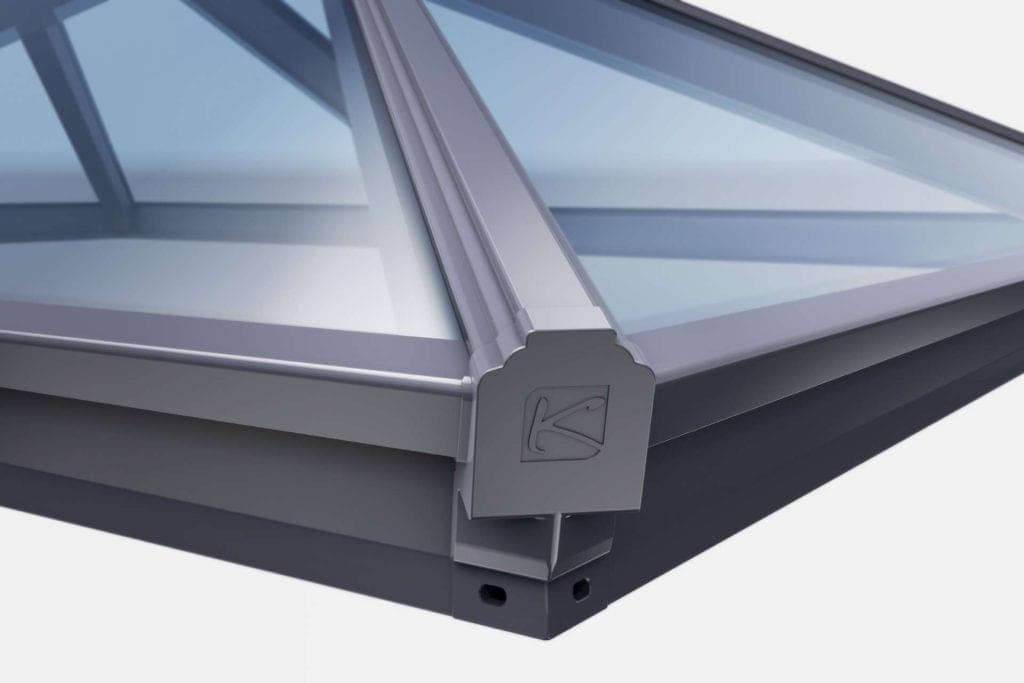
The Korniche frame and ridge are extruded aluminium with a high-strength polymer insulating core that runs through the entire structure, and the fasteners are thermally isolated. This separates the inner and outer aluminium sections so heat does not conduct directly through the metal. It stops the frame from undermining the performance of the glass.
2. Reduced-width ridge
Korniche reduced the width of the ridge, hips and rafters. The thinner the ridge, the less aluminium running across the top of the lantern, and the smaller the heat-bridge path. Wider ridges lose materially more heat at the apex. For more on the ridge specifically see our Korniche brand hub and Slim vs Standard Roof Lanterns.
3. High-spec double-glazed units as standard
The standard glazing is 28mm double-glazed units, and every glazed unit on the Korniche lantern is:
- Filled with argon gas
- Sealed with a warm edge spacer bar
Where Korniche Sits in the UK Roof Lantern Market
Korniche's 1.2 W/m²K glass U-value (1.0 on the Premium range) is a strong glass specification. Mid-range and budget rooflights typically publish overall (whole-product) U-values from 1.4 W/m²K up to 2.0 W/m²K, which are not directly comparable with a glass-unit figure. Specialist Passivhaus rooflights can reach below 0.8 W/m²K but at a price step well above the residential aluminium market.
The gap matters most on extension rooflights specified at 3m × 2m or larger, where the rooflight area is significant relative to the room volume. For our wider assessment of Korniche see the Korniche review on our Korniche page.
Should You Upgrade to the Premium Glass?
Korniche's Premium glass range lowers the glass U-value from 1.2 to 1.0 W/m²K, still in 28mm argon-filled double-glazed units. The upgrade is worth considering in two scenarios:
Scenario 1: Passivhaus or Future Homes Standard project
If the wider project targets Future Homes Standard 2026 compliance, the rooflight needs to contribute to the building's overall thermal performance, and the Premium glass range is the right Korniche specification. For a certified Passivhaus build, confirm the rooflight requirement with your energy assessor, as specialist Passivhaus rooflights sit at 0.8 W/m²K or below.
Scenario 2: Large rooflight area on north-facing aspect
A 4m × 3m Korniche on a north-facing kitchen extension is losing heat without solar gain to compensate. The 1.0 W/m²K vs 1.2 W/m²K upgrade is meaningful here.
For most standard residential extensions, the standard Korniche glass at 1.2 W/m²K is the right specification.
Solar Control Glass — A Different Decision
U-value measures heat loss in winter. Solar control glass is a separate consideration that addresses solar gain in summer. Korniche offers two solar control options:
- Blue tinted solar control — reduces solar heat gain materially, with a blue tint visible from inside
- Neutral solar control — reduces solar heat gain with no visible colour change
South-facing or west-facing kitchen extensions usually benefit from solar control glass even on the standard Korniche specification. The blue tint is more effective on heat rejection but visible from inside; the neutral option is the right call where the visual purity of the lantern matters. Specific g-values for both options are confirmed at quote stage.
Self-Cleaning Glass as Standard
Every Korniche glass type is self-cleaning as standard. A transparent coating reacts with daylight to break down dirt, which then washes away in the rain. On a roof lantern that is rarely accessible for manual cleaning, this is a meaningful long-term advantage.
Because every glass type carries the coating, the U-values above already include it.
What the U-Value Means in Practice
For a typical Korniche specification — 3m × 2m, standard double glazing, on a kitchen extension — the U-value translates roughly as follows:
- Heat loss at 0°C outside, 21°C inside: approximately 150 watts continuous through the rooflight (calculated from the 1.2 W/m²K glass U-value × 6 m² × 21K)
- Annual heating contribution of the rooflight: depends on the heating system, insulation elsewhere, and occupancy patterns, but typically modest in absolute terms
The point is not the running cost (which is small relative to the total heating bill), but comfort. A rooflight glazed at 1.2 W/m²K does not produce a cold zone underneath it the way a 2.0 W/m²K rooflight does. The room feels evenly warmed in winter rather than cold near the lantern.
Getting the U-Value Right at Survey
A few practical points the Vitrum Solutions survey team checks at every Korniche installation:
- Aperture preparation — the structural opening must be lined and insulated correctly so the U-value of the surrounding roof matches the rooflight tier. A 1.2 W/m²K Korniche bolted into uninsulated joists is wasted spec.
- Air-tightness sealing — the gasket between the lantern frame and the kerb must be continuous. Air leakage is invisible on the spec sheet but significant in practice.
- Cold bridging at the kerb — the timber or upstand kerb the lantern sits on needs its own thermal break detail. Easy to miss on first-time builds.
These details are not optional extras. They are the difference between the Korniche performing at its rated U-value in the real building and underperforming silently for 30 years. Every Korniche installation Vitrum Solutions completes is FENSA registered (Building Regulations compliant) with a 10-year CPA insurance-backed guarantee on the workmanship.
Frequently Asked Questions
What is the U-value of a standard Korniche roof lantern?
The standard Korniche uses 28mm argon-filled double-glazed units with a glass U-value of 1.2 W/m²K on the Clear, Neutral and Blue glass, or 1.0 W/m²K on the Premium range. Approved Document L sets 2.2 W/m²K for a rooflight in England, measured for the whole unit; Korniche publishes its figure for the glass unit.
Can Korniche reach lower U-values for high-performance projects?
Yes. Korniche's Premium glass range lowers the glass U-value from 1.2 to 1.0 W/m²K. The Korniche roof lantern is glazed in 28mm argon-filled double-glazed units only, so there is no triple-glazed lantern option.
Is the Korniche U-value good enough for Building Regulations?
Yes. Approved Document L sets 2.2 W/m²K for a rooflight in England, measured for the whole unit, and the standard Korniche glass unit is rated at 1.2 W/m²K. Vitrum Solutions handles FENSA registration on every Korniche installation we complete, so Building Regulations compliance is documented automatically.
How does Korniche compare to a standard mass-market rooflight on U-value?
Korniche's 1.2 W/m²K glass U-value is a strong figure against mass-market rooflights, which typically publish 1.6-2.0 W/m²K for the whole product. When comparing quotes, ask each supplier for both the glass-unit and the whole-rooflight figure so you compare like with like.
Should I upgrade my Korniche to the Premium glass for the U-value gain?
For most residential extensions the standard Korniche glass at 1.2 W/m²K is the right specification. Choose the Premium range at 1.0 W/m²K if the wider project targets Future Homes Standard 2026 compliance, or if the rooflight area is large on a north-facing aspect.
Does Korniche U-value performance degrade over time?
The aluminium frame and thermal break are dimensionally stable and do not degrade. The argon fill in the double-glazed units depletes slowly over time (typically 1% per year). Korniche's manufacturer warranty covers the frame and hardware for 10 years on domestic installations.
What is the difference between U-value and energy rating on a roof lantern?
U-value measures heat loss in W/m²K and is the universal building-regulations metric. Energy rating (A++, A, B etc) is a UK consumer-facing rating that combines U-value, solar gain and air leakage into a single letter grade. For roof lanterns the U-value is the more reliable comparison metric because the energy rating system was designed for vertical windows and translates imperfectly to rooflights.
Getting a Quote
Vitrum Solutions installs Korniche roof lanterns across Buckinghamshire, Berkshire, Oxfordshire, Surrey, Hampshire, Hertfordshire and West London. Request a free quote and we will specify the right Korniche tier for your project (standard or Premium glass, solar control, laminated or privacy) based on aperture size, orientation and the wider thermal envelope.
For more on Korniche specifically see our Korniche brand hub and Korniche Slim Ridge child URL. For roof-lantern context across the UK market see Slim Roof Lanterns vs Standard and Korniche review on our Korniche page.
Need advice on your next project?
Talk it through with the team, or leave your details for a free no-obligation written quote.
FENSA registered · 10-year CPA insurance-backed guarantee · Cortizo, Schuco & Rehau approved · Origin Approved Partner