Windows & Doors in Conservation Areas: UK Guide 2026
Living in a conservation area comes with genuine advantages — protected streetscapes, maintained architectural character and often higher property values. But it also comes with restrictions that can catch homeowners off guard when they want to replace their windows and doors.
The rules around window and door replacements in conservation areas are more complex than in standard residential areas, and getting them wrong can result in enforcement action, fines and the expensive requirement to undo completed work. This guide explains the planning framework in England as of 2026, covering conservation areas, Article 4 directions, heritage-appropriate products and listed buildings.
What Is a Conservation Area?
A conservation area is an area of special architectural or historic interest, designated by the local planning authority under the Planning (Listed Buildings and Conservation Areas) Act 1990. There are approximately 10,000 conservation areas across England, ranging from historic town centres and Georgian squares to Victorian suburbs and rural villages.
The purpose of conservation area designation is to manage change, not prevent it. You can still improve your property — but the improvements must preserve or enhance the character of the area. For windows and doors, this means the replacement products must be appropriate in terms of:
- Material — timber, aluminium or uPVC depending on local policy
- Design — matching the proportions, opening style and detailing of the original windows
- Colour — often restricted to white, heritage colours or colours matching the existing scheme
- Glazing pattern — Georgian bars, astragal bars or plain glass as appropriate to the building period
Do You Need Planning Permission?
The answer depends on two factors: whether your conservation area has an Article 4 Direction in place, and which elevation of the building you are working on.
Without an Article 4 Direction
If your conservation area does not have an Article 4 Direction covering windows and doors, the standard permitted development rights apply:
- Like-for-like replacement: Replacing existing windows with new ones of similar appearance (material, colour, design) does not require planning permission. "Similar appearance" is the key phrase — it does not mean identical, but the replacement should not alter the building's character
- Change of material: Replacing timber windows with uPVC may require planning permission if the change is considered to affect the building's appearance. This varies by local authority — some are relaxed about rear elevations, while others require timber-effect materials on all elevations
- Front and side elevations: Changes to the front elevation visible from the highway are more likely to require permission, even without an Article 4 Direction. Conservation area policy typically provides additional protection for principal elevations
With an Article 4 Direction
An Article 4 Direction is issued by the local authority to remove specific permitted development rights. In conservation areas, Article 4 Directions commonly cover:
- Replacement of windows and doors on any elevation
- Changes to external materials, colours or finishes
- Addition of satellite dishes, solar panels or other external fixtures
- Alterations to boundary walls, fences and gates
If an Article 4 Direction applies to your property and covers windows, you need planning permission for any window or door replacement, even a like-for-like swap. The good news is that planning applications made necessary by an Article 4 Direction are free of charge — there is no application fee.
How to Check
1. Visit your local authority planning portal and search for your address 2. Check the conservation area boundary map 3. Look for any Article 4 Directions listed against your street or area 4. Contact the planning department if unsure — most offer free advice for conservation area enquiries
What Windows and Doors Are Acceptable?
Acceptable products vary by conservation area and local authority policy. Here are the general principles:
Timber Windows
Timber remains the default preference in most conservation areas, particularly for front elevations of pre-1930 buildings. Local authorities favour timber because it matches the original construction material and can be machined to precisely replicate historical profiles — including horns on sash windows, slim meeting rails, and detailed mouldings.
Modern engineered timber windows offer significantly better performance than the originals while maintaining the same appearance. Heritage-specification timber sits at the upper end of the market, above both standard uPVC and conservation-appropriate uPVC sash. For current installed prices, see our sash window cost guide.
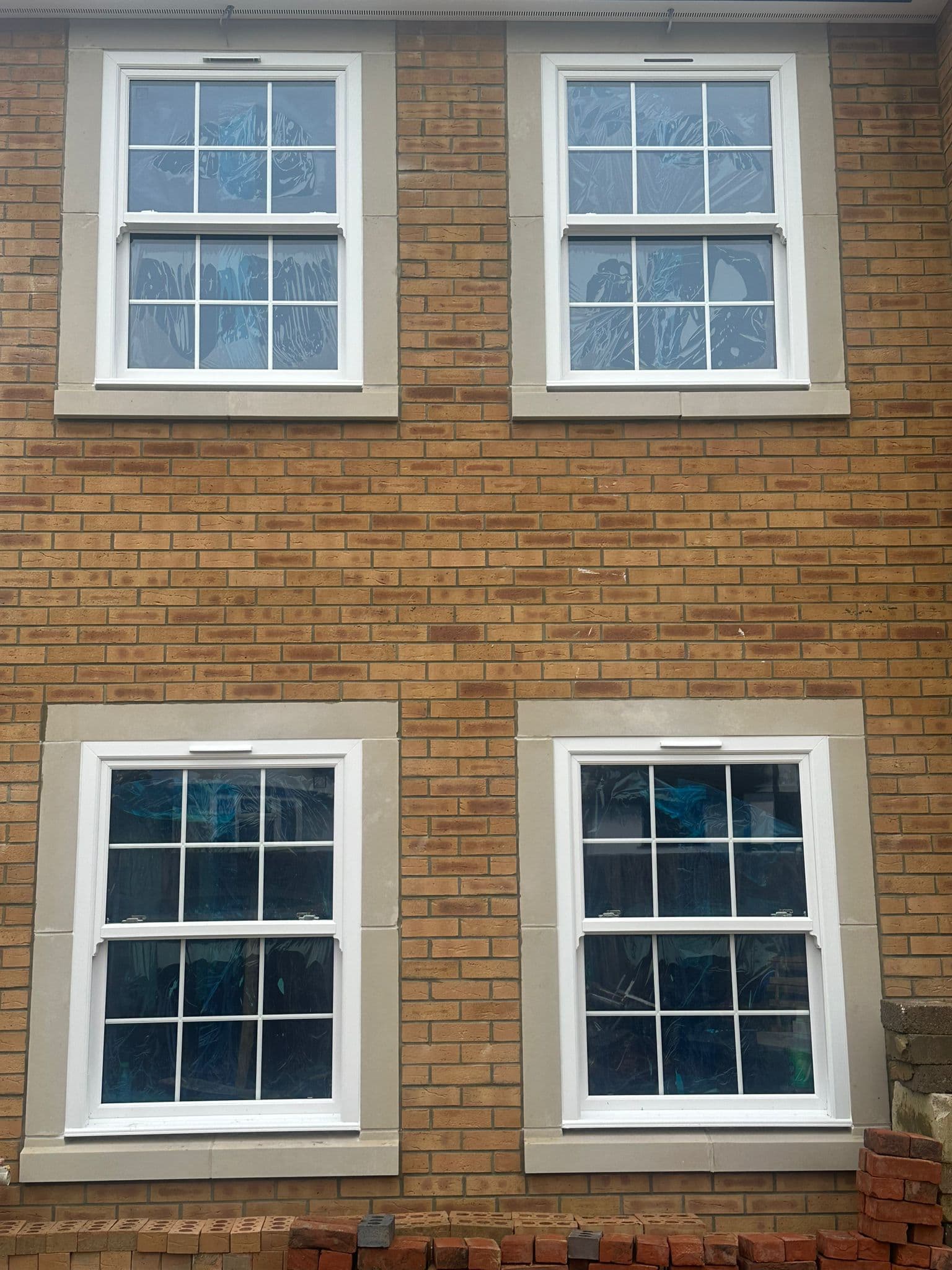
uPVC Sliding Sash Windows
Here is where things get interesting. Modern uPVC sliding sash windows have evolved dramatically in recent years. Premium systems now offer:
- Slim sightlines that closely match the proportions of original timber sash windows
- Woodgrain foils in white, cream, oak, rosewood and heritage colours
- Run-through sash horns that replicate the joinery detail of traditional sash windows
- Deep bottom rails matching the proportions of Victorian and Georgian originals
- Astragal glazing bars that create the appearance of multi-pane glazing
Some local authorities now accept high-quality uPVC sash windows in conservation areas, particularly on rear and side elevations. The Rehau Heritage system, for example, has been approved in numerous conservation areas across the South East due to its close visual match to timber originals.
However, other authorities maintain a strict timber-only policy, at least for front elevations. The only way to know for certain is to check your local conservation area policy and, ideally, submit a pre-application enquiry before ordering.
Aluminium Windows
Aluminium is increasingly accepted in conservation areas for specific applications:
- Rear extensions: Modern aluminium windows and doors on a clearly contemporary rear extension are often acceptable, as they read as a deliberate modern intervention rather than an attempt to replicate historic materials
- Crittall-style replacements: Properties with original steel Crittall windows can replace them with slimline aluminium equivalents that maintain the same sightlines and proportions
- Commercial properties: Shopfronts and commercial buildings within conservation areas may have more flexibility for aluminium
For domestic front elevations on period buildings, aluminium is rarely the first choice in conservation area applications. However, slim-profile aluminium casement windows with heritage detailing are gaining acceptance in some areas.
Entrance Doors
Entrance doors in conservation areas follow similar principles to windows:
- Timber panel doors are the default expectation for period properties
- Composite doors designed to replicate timber panel doors (such as Palladio) are increasingly accepted, though some authorities require timber on principal elevations
- Steel security doors may face resistance in conservation areas unless designed to match the building's character
- uPVC doors are rarely acceptable on front elevations in conservation areas
Listed Buildings: A Higher Standard
If your property is listed (Grade I, II* or II), the requirements go beyond conservation area rules. You need listed building consent for any alteration that affects the building's character or appearance — including window and door replacements.
Key Differences from Conservation Area Rules
| Factor | Conservation Area | Listed Building |
|---|---|---|
| Replacement windows | May be permitted development | Always needs consent |
| Like-for-like replacement | Usually fine | Still needs consent |
| Internal changes | Not controlled | Controlled if they affect character |
| Rear elevations | Often more relaxed | Same rules as front |
| Enforcement | 4-year time limit | No time limit |
| Penalties | Planning enforcement | Criminal offence |
What Gets Approved for Listed Buildings?
For listed buildings, the expectation is almost always timber windows and doors made to match the originals as closely as possible. The planning officer will assess:
- Profile and proportions: The glazing bars, meeting rails, stiles and sash horns must match the original design
- Glass: Some officers require hand-blown or drawn glass to match the historical glass character
- Hardware: Ironmongery should be period-appropriate — no modern espagnolette handles on a Georgian sash
- Opening mechanism: The opening style must match the original (e.g., sliding sash, side-hung casement)
Double glazing in listed buildings is a sensitive topic. Some authorities accept slim-profile double-glazed units (vacuum-sealed or heritage slim units at 12-14mm total thickness), while others insist on single glazing with secondary glazing on the interior side. Discuss this with your conservation officer before proceeding.
The Planning Application Process
If you need planning permission for window or door replacement in a conservation area, here is what to expect:
Pre-Application Advice (Recommended)
- Cost: Free for Article 4 enquiries; most councils charge a fee for general pre-app advice, so check the current rate on your council's website
- Timescale: 4-6 weeks for a written response
- What to submit: Photos of existing windows, proposed product details, and a brief description of the changes
- Why bother: Pre-app advice significantly reduces the risk of a refused application
Full Planning Application
- Cost: Free if required by Article 4 Direction; otherwise the national householder application fee applies (check the current amount on the Planning Portal or GOV.UK)
- Timescale: 8 weeks from validation to decision
- What to submit: Application form, site plan, elevation drawings showing existing and proposed, product specifications, heritage statement (if requested)
- Consultation: Neighbours are notified, and the conservation officer reviews the application
Listed Building Consent
- Cost: Free (no application fee)
- Timescale: 8-12 weeks
- What to submit: Listed building consent application form, detailed drawings, heritage impact assessment, product specifications, methodology statement
- Specialist advice: We recommend engaging a heritage consultant for listed building applications. Their fees vary with the complexity of the building, so agree the fee in writing before you instruct one
Common Mistakes to Avoid
1. Assuming "the back doesn't matter" — Even in conservation areas without Article 4 Directions, rear elevations are not automatically exempt. Check before proceeding 2. Ordering before getting consent — If planning permission is required, submit the application before ordering windows. Manufacturers will not refund custom-made products 3. Choosing uPVC without checking policy — Many conservation areas restrict or prohibit uPVC on visible elevations. A refused application after installation means removal at your cost 4. Ignoring Building Regulations — Even with planning permission, you still need Building Regulations compliance via FENSA or Building Control 5. Forgetting about colour — Conservation area policies often specify acceptable colours. RAL 9010 (pure white) may not be acceptable where RAL 9001 (cream white) is required
How Vitrum Solutions Can Help
We install windows and doors across Buckinghamshire, West London and the surrounding areas — including numerous conservation areas in towns like Beaconsfield, Marlow, Amersham, Chalfont St Giles and Gerrards Cross. Our range includes:
- uPVC sliding sash windows — heritage-appropriate designs for conservation areas
- Aluminium flush casement windows — slim-profile options for approved modern interventions
- Palladio composite doors — high-quality entrance doors with traditional panel designs
- Victorian slider windows — authentic sliding sash appearance with modern performance
We can advise on what is likely to be acceptable in your specific conservation area and support the planning application process where needed. Call 0800 861 1450 or get a free quote.
Frequently Asked Questions
Can I use uPVC windows in a conservation area?
It depends on the local authority's conservation area policy and whether an Article 4 Direction is in place. Some authorities accept high-quality uPVC with heritage detailing, particularly on rear and side elevations. Others require timber on all visible elevations. Premium uPVC sliding sash windows with woodgrain foils and traditional proportions have the best chance of approval.
What happens if I replace windows without permission in a conservation area?
If planning permission was required (due to an Article 4 Direction or the change not being like-for-like), the local authority can issue an enforcement notice requiring you to remove the unauthorised windows and install compliant replacements — at your expense. They have 4 years from the date of installation to take enforcement action. For listed buildings, the consequences are more serious — it is a criminal offence carrying unlimited fines.
How much more do conservation-area-compliant windows cost?
Heritage-specification timber windows sit at the upper end of the market and cost substantially more than standard uPVC. Conservation-appropriate uPVC sash windows fall between the two, carrying a premium over standard uPVC while costing well below heritage timber. For current installed prices, see our sash window cost guide or request an itemised written quote. The premium is significant but unavoidable if you want to meet planning requirements.
Can I get double glazing approved in a listed building?
Increasingly, yes. Slim-profile double-glazed units (12-16mm total thickness) are now accepted by many conservation officers, particularly where the original glass has already been replaced. Vacuum-insulated glazing (VIG) — at just 6-8mm thick — is gaining traction as a heritage-friendly alternative. However, some officers still insist on single glazing with internal secondary glazing. Always discuss with your conservation officer before specifying.
Are there grants for replacing windows in a conservation area?
Not in general. Public heritage funding for private homes is rare: Historic England supports homes only in exceptional cases and for repair, and some council heritage schemes explicitly exclude replacement windows and double glazing. Energy-efficiency schemes are aimed mostly at households on low incomes or benefits and fund glazing only in limited cases. Vitrum Solutions does not offer or arrange grants; our honest guide to window grants sets out who qualifies for what.
Do I need to match the exact colour of existing windows?
In most cases, the replacement windows should match or be sympathetic to the existing colour scheme. If all properties on your street have white windows, installing anthracite grey windows is unlikely to be approved. Many conservation areas specify acceptable colours in their management plan. If in doubt, match the existing colour — you can always apply to change the colour later if you want something different.
Need advice on your next project?
Talk it through with the team, or leave your details for a free no-obligation written quote.
FENSA registered · 10-year CPA insurance-backed guarantee · Cortizo, Schuco & Rehau approved · Origin Approved Partner