Gerda Steel Doors Review: RC2 Standard, RC3 Upgrade Tested
Gerda is a Polish manufacturer that has become synonymous with high-security residential entrance doors in the UK market. Their steel doors carry some of the highest security certifications available for domestic use, and they have built a strong reputation among homeowners who take security seriously. But do the doors live up to the claims, and are they worth the premium?
This review is based on our experience as approved Gerda installers, covering everything from the security testing to the day-to-day living experience.
What Is Gerda?
Gerda is one of Europe's largest manufacturers of security entrance doors, producing over 100,000 doors per year from their factories in Poland. They have been manufacturing steel security doors for over 30 years and supply markets across Europe, including a rapidly growing UK presence.
Their residential range is built around a steel door leaf (typically 1.2-2.0mm thick steel panels) with a multi-layer insulation core, advanced locking systems and a wide range of decorative finishes. The doors are tested and certified to BS EN 1627:2011, with RC2 (Resistance Class 2) as standard across the range, and RC3 available as an upgrade on the Optima and Thermo Premium ranges.
Security Certification Explained
Understanding the security ratings is essential when evaluating Gerda doors:
RC2 (Resistance Class 2) - Tested to **EN 1627:2011** - Resists attack with simple tools (screwdrivers, pliers, wedges) for **3 minutes** - Equivalent to UK PAS 24 standard - Suitable for most residential applications
RC3 (Resistance Class 3) - Tested to **EN 1627:2011** - Resists attack with professional tools (crowbars, drills, hacksaws) for **5 minutes** - Significantly exceeds PAS 24 - Recommended for high-value properties and higher-risk locations
What RC3 Testing Actually Involves During RC3 testing, a team of professional testers attempts to breach the door using a defined set of tools over a specified time period. The tools include crowbars up to 750mm, drills, screwdrivers, chisels and hacksaws. The door must withstand this sustained professional attack for a minimum of 5 minutes without allowing entry.
To put this in context: most residential burglaries in the UK are completed in under 60 seconds. An RC3-rated door provides resistance that is orders of magnitude beyond what any burglar would encounter — or attempt to overcome.
Gerda Door Construction
Door Leaf The door leaf (the panel itself) is constructed from:
- Outer steel skin: 1.2-2.0mm galvanised steel
- Inner steel skin: 1.0-1.5mm galvanised steel
- Insulation core: High-density mineral wool or polyurethane foam (50-80mm thick)
- Reinforcement plates: Additional steel around the lock zone, hinges and vulnerable areas
- Anti-drill plates: Hardened steel inserts that destroy drill bits
Locking System Gerda doors use multi-point locking systems with:
- 8-14 locking points (depending on the model)
- Motorised lock option — locks automatically when the door closes
- Anti-snap, anti-bump, anti-pick cylinders with key-card registration
- Deadbolts, hook bolts and pin bolts distributed around the full perimeter
- Dog bolt hinges — the door locks into the frame on the hinge side as well as the lock side
Frame and Threshold - **Steel frame** with thermal break - **Concealed hinges** — no external hinge pins to attack - **Three-point weather seal** around the full perimeter - **Aluminium threshold** with thermal break and weather seal
Thermal Performance
This is where many people expect steel doors to fall short — but modern Gerda doors are surprisingly well-insulated:
- U-value: 0.74 to 1.3 W/m²K depending on the model
- Solid panel door: U-values as low as 0.8 W/m2K
- Thermal break: Integrated polyamide thermal break in the frame prevents cold bridging
These figures compare favourably with premium composite doors, which typically achieve 1.0-1.4 W/m2K. The old perception that steel doors are cold is outdated — a well-specified Gerda door is no less thermally efficient than the best composite alternatives.
Design and Customisation
Gerda doors are available in a broader range of styles than many people expect:
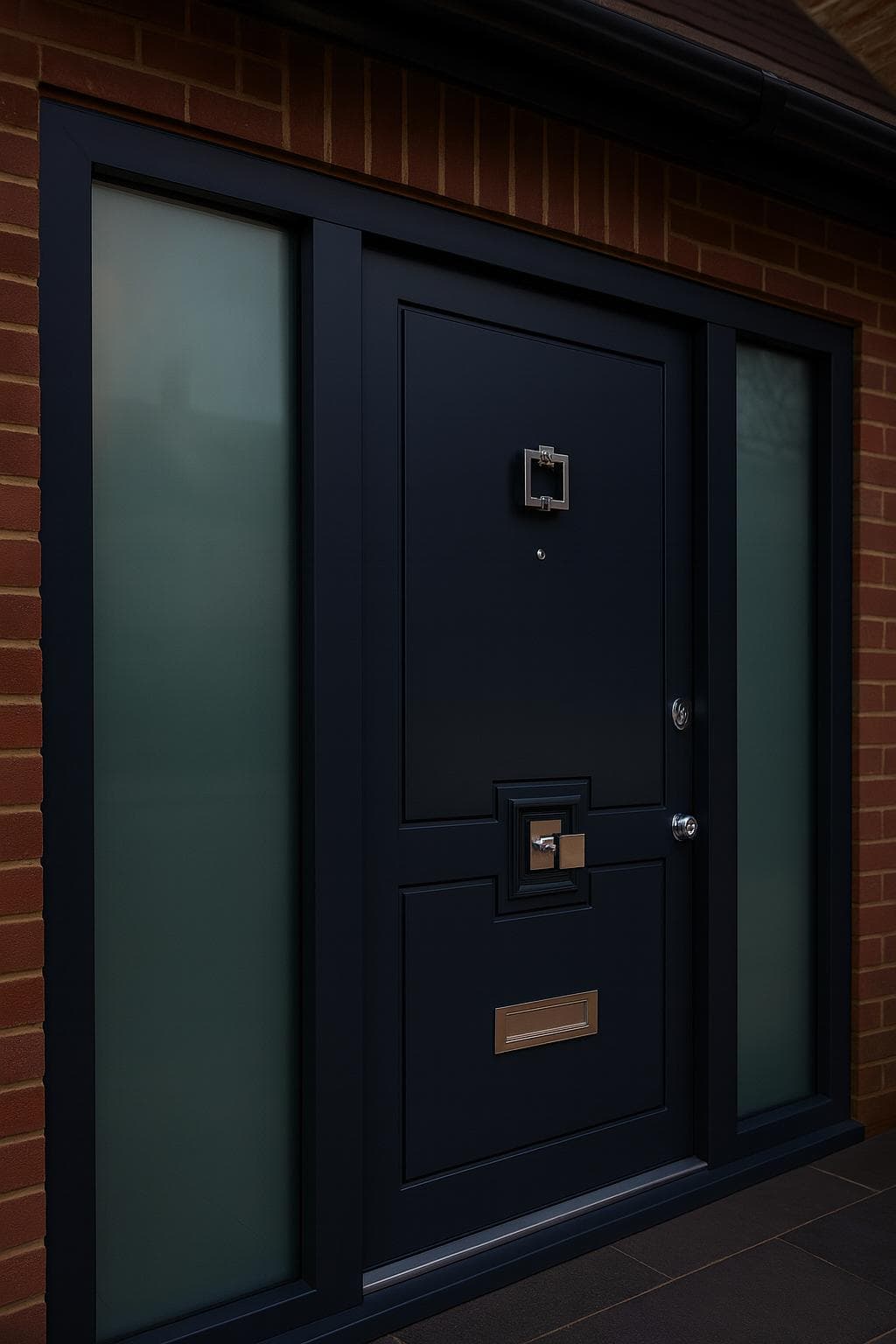
Exterior Finishes - **Smooth painted finishes** in any RAL colour - **Woodgrain-effect laminates** — oak, walnut, mahogany, anthracite - **Brushed stainless steel** panels - **CNC-milled decorative patterns** — geometric, contemporary and traditional designs
Glass Options - **Clear double-glazed panels** — various sizes and positions - **Frosted and obscured glass** - **Stained-glass effect panels** - **Sidelights** — single and double configurations - **Top-lights** for properties with tall openings
Hardware - **Lever handles** in stainless steel, chrome, gold or black - **Pull handles** — long bar handles in various lengths and finishes - **Lion-head knockers** and traditional furniture - **Fingerprint readers** and smart lock options - **Spy holes and video intercom integration**
The level of customisation is impressive. Each door is built to order with your chosen combination of panel design, colour, glass and hardware. There are no off-the-shelf configurations — every Gerda door is bespoke.
Our Installation Experience
As approved Gerda installers, we have fitted these doors across a wide range of properties. Here are our honest observations:
What We Like - **Build quality is exceptional.** The doors feel substantial — typically 70-100kg — and the fit and finish is consistently excellent - **The locking systems are the best available** for residential use. The motorised lock option is particularly impressive — the door locks itself the moment it closes - **Customer reaction is universally positive.** Homeowners consistently comment on the solid feel and the confidence the door provides - **Thermal performance** is better than expected. No cold spots, no condensation, no draughts
What to Be Aware Of - **Weight.** Gerda doors are heavy. The hinges handle this well, but the door takes a little more effort to open and close than a composite door. Most homeowners adapt within a day - **Lead time.** Because every door is built to order in Poland, the typical lead time is **6-10 weeks** from order to delivery. This is longer than most composite door manufacturers - **Installation complexity.** Steel doors require precise installation. The frame must be perfectly level and plumb, and the fixing method differs from composite or uPVC. This is not a job for a general builder — it requires an experienced, approved installer
Pricing
Gerda steel doors are premium products priced accordingly, and the price climbs with the specification:
- RC2 door (solid panel, standard hardware): the entry point to the Gerda range
- RC3 door (solid panel, premium hardware): a step up from RC2
- RC3 door with sidelights: higher again, as the sidelights enlarge the opening
- RC3 door with motorised lock and smart features: towards the top of the range
- Double doors (pair): the highest-priced configuration
Our Gerda quotes include supply, professional installation, removal of the old door and FENSA certification.
For comparison, from entry level to the top of the market: - uPVC front door: Entry - Standard composite door: Mid - Palladio composite door: Premium composite - Gerda RC2 steel door: Premium steel - Gerda RC3-upgrade steel door (Optima or Thermo Premium): Top of the range
For current figures, see our guides to steel door costs and composite door costs, or request an itemised written quote.
Who Should Choose a Gerda Steel Door?
Gerda doors are the right choice for:
- High-value properties where security is a genuine concern
- Homes in higher-risk areas with above-average burglary rates
- Homeowners who want the absolute best security available for a residential front door
- Properties storing valuable items (art, jewellery, collections)
- Insurance requirements — some high-value home insurance policies require or incentivise RC-rated doors
They may not be necessary for:
- Standard suburban homes with low burglary risk (a quality composite door provides excellent security)
- Properties where the budget could be better allocated elsewhere
- Homes where the aesthetic priority is a traditional timber look (composite or timber doors may suit better)
Visit our Gerda steel doors page for the full range, or compare with our steel front doors collection from our SteelR brand.
Frequently Asked Questions
Are Gerda doors the most secure residential door in the UK?
Gerda RC3-upgraded steel doors (Optima or Thermo Premium) are among the most secure residential entrance doors available anywhere. The RC3 certification exceeds the UK PAS 24 standard significantly and represents the highest security class commonly fitted to homes. Only specialist safe-room doors offer higher ratings.
How heavy are Gerda steel doors?
Gerda steel doors typically weigh between 70 and 100kg, depending on the model, size and glazing. The heavy-duty concealed hinges are designed for this weight and provide smooth operation. The door is heavier to swing than a composite door but this is a deliberate design feature that contributes to the security performance.
Do Gerda steel doors rust?
No. The steel is galvanised and then powder-coated or laminated, providing multiple layers of corrosion protection. The galvanisation alone would prevent rust for decades, and the exterior finish adds further protection. We have not seen a single instance of corrosion on any Gerda door we have installed.
How long is the wait for a Gerda door?
Typical lead time is 6-10 weeks from order confirmation to delivery. This is because every door is manufactured to order in Gerda's Polish factory. We recommend ordering well in advance of your desired installation date, particularly during busy spring and summer periods.
Can I get a Gerda door with a smart lock?
Yes. Gerda offers motorised locking systems that can be integrated with fingerprint readers, keypads and smart home systems. The motorised lock option automatically engages all locking points when the door closes, providing maximum security without needing to manually lock the door.
Do Gerda doors meet UK Building Regulations?
Yes. Gerda doors achieve U-values of 0.74 to 1.3 W/m²K depending on the model, which meets and exceeds the Building Regulations Part L requirement for external doors. All our Gerda installations include FENSA certification as standard.
Need advice on your next project?
Talk it through with the team, or leave your details for a free no-obligation written quote.
FENSA registered · 10-year CPA insurance-backed guarantee · Cortizo, Schuco & Rehau approved · Origin Approved Partner