Bifold vs Sliding vs French Doors: Which Is Best in 2026?
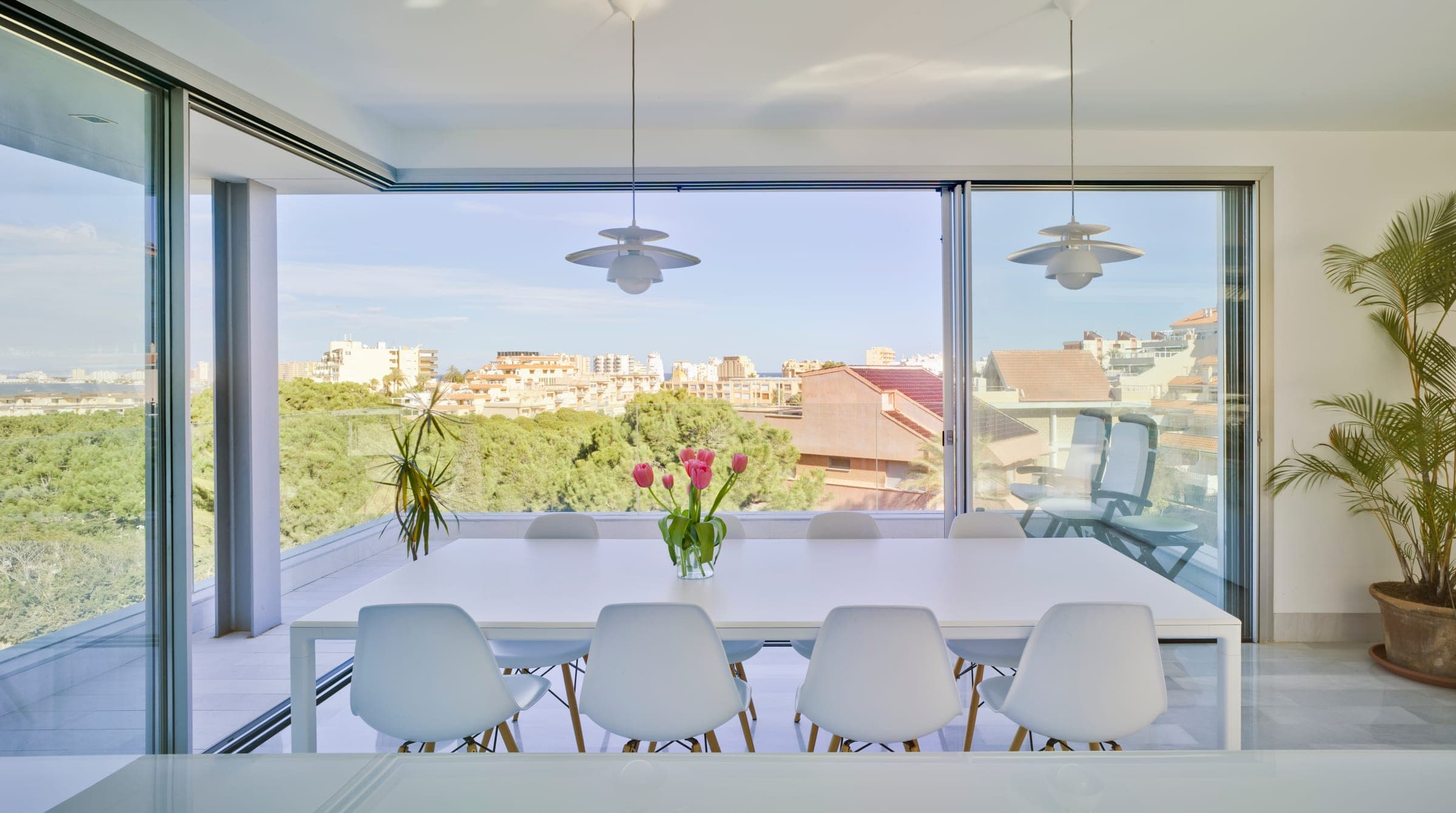
When you are planning a rear extension, a kitchen-diner refit or any project that opens the back of the house to the garden, three glazing options dominate the conversation: bifold, sliding and French doors. Each one connects inside and outside in a different way, each has its own cost profile and each suits a different type of property.
Most online comparisons stop at two of the three. This guide covers all three side by side so you can choose the right format for your opening, your property and your lifestyle, rather than defaulting to whatever your installer prefers to sell.
At Vitrum Solutions we install all three formats across Buckinghamshire, Berkshire, Oxfordshire, Surrey, Hampshire, Hertfordshire and West London, so the comparison below reflects what we see on real jobs rather than catalogue marketing.
How Each Door Type Works
Bifold doors
Bifold doors are multiple panels hinged together that fold concertina-style to one or both sides of an opening. When fully folded open, the panels stack tightly against the side jamb and roughly 90% of the aperture becomes walk-through. Most sets include a single "traffic door" that opens independently for everyday access without folding the whole set.
Typical configurations run from 2-panel (1.8m wide) up to 8-panel (6m+ wide). Folding can be inward or outward, left or right.
Sliding doors
Sliding doors are large glass panels that glide horizontally on tracks. One panel slides behind another, so at any given moment between 50% and 66% of the opening is accessible. The panels never leave the frame, they only change position.
Sliding is usually 2-panel (one fixed, one sliding), 3-panel (two fixed, one sliding, or one fixed and two sliding from the middle) or 4-panel pocket systems that slide into wall cavities.
French doors
French doors are a pair of hinged doors that meet in the middle, like a traditional double door. Both panels open inward or outward and there is no central mullion on premium systems (a rebated meeting stile hides the junction when closed). The typical opening width is 1.2m to 2.4m.
French doors are the oldest of the three formats and remain hugely popular for cottage-style, period and traditional properties.
Sightlines and Aesthetics
Sightline means the width of visible frame between glass panels. Narrower sightlines equal more glass and a cleaner look.
- Sliding doors: 20 to 35mm on premium systems (Cortizo Cor Vision Sliding, Schuco ASS 77 PD Panorama)
- French doors: 80 to 120mm at the centre meeting stile (narrower elsewhere)
- Bifold doors: 36 to 128mm per hinge joint, so a 4-panel bifold has three hinge joints of frame dividing the view
When closed, a sliding door wall reads as an almost uninterrupted sheet of glass. French doors have a single vertical line of frame down the middle. Bifolds have three or five vertical frame lines depending on panel count.
If the view is the reason you are replacing the door, sliding wins. If symmetry and traditional character matter more, French doors win. Bifolds come third on looks when closed, though they are the only option that disappears entirely when fully opened.
Opening Width and Everyday Use
This is where bifolds fight back.
- Bifolds: up to 90% of the aperture becomes walk-through when fully folded
- French doors: 100% walk-through within the door width (but door widths are limited to around 2.4m maximum)
- Sliding doors: 50 to 66% walk-through maximum
For a wide opening (3 to 6 metres) bifolds are the only option that lets you fully connect inside and outside. For a narrow opening (1.2 to 2.4 metres) French doors give you the same effect at lower cost.
The honest reality of UK weather: most homeowners open their bifolds fully 10 to 20 days per year. For the remaining 345 days, the traffic door handles daily use and the view through the closed set is what you actually live with. That view is materially better through sliding doors.
Thermal Performance
U-value is the metric, lower is better, Building Regulations minimum is 1.4 W/m²K.
- Sliding doors: 1.0 to 1.4 W/m²K on premium systems
- French doors: 1.2 to 1.5 W/m²K
- Bifolds: 1.3 to 1.6 W/m²K (more hinge joints equal more thermal bridges)
Sliding doors also tend to be more airtight because the compression seal between panels is continuous, whereas bifolds have multiple hinge and seal points that can degrade over a 20 to 30 year life. Over a decade the airtightness difference probably matters more than the raw U-value difference.
Weather Resistance
British rain and wind test door systems hard.
- Sliding doors: raised track designs handle driving rain well, wind load is excellent because the panels are heavy and set into a track
- French doors: good rain resistance with proper thresholds, moderate wind performance (a wide French door flapping open in a gust is a classic British summer experience)
- Bifolds: acceptable rain resistance, the weakest wind performance of the three because partly opened panels catch gusts
For exposed sites (coastal, hilltop, flat open gardens) sliding is usually the safest choice. For sheltered sites any format works.
Security
All three formats can achieve PAS 24:2022 on premium systems from Cortizo, Schuco and Rehau.
- Sliding doors: multi-point locking along the full meeting stile, interlocking track makes panel lifting very difficult
- French doors: multi-point locking with shoot bolts top and bottom, plus locked meeting stile
- Bifolds: multi-point locking on the traffic door plus shoot bolts on each secondary panel
No format is inherently more or less secure than the others when specified to PAS 24. What matters is the installer fitting it correctly, the door being from a tested system and the glass being laminated or toughened at low level per Approved Document K.
Cost Comparison (2026 UK Prices, Installed)
Ranges below are for premium brand, installed, including FENSA registration and 10-year CPA insurance-backed guarantee.
3m opening
- French doors (2.4m maximum, so 3m needs flanking sidelights): £4,500 to £7,500
- Bifold doors (3-panel): £6,500 to £11,000
- Sliding doors (2-panel): £8,000 to £14,000
4m opening
- Bifold doors (4-panel): £8,500 to £14,500
- Sliding doors (2 or 3-panel): £10,000 to £17,000
- French doors: not typically viable at this width
6m opening
- Bifold doors (6-panel): £12,500 to £21,000
- Sliding doors (3 or 4-panel): £14,000 to £24,000
- French doors: not viable at this width
Premium sliding consistently costs 15 to 30% more than equivalent bifold because the glass panels are larger and heavier and the tracks are engineered to support hundreds of kilograms. For detailed breakdowns see our bifold doors cost guide and sliding doors vs bifold doors comparison.
Which Is Right for Your Property?
Choose bifold doors if:
- Your opening is 3 metres or wider
- You actively want to unify inside and outside for entertaining
- Your site is reasonably sheltered from wind
- Budget is tighter than sliding allows
- You like the folded-back aesthetic when fully open
Choose sliding doors if:
- The view through closed doors is the most important factor
- You want the cleanest contemporary architectural look
- Thermal performance is a priority (future-proofing against tightening Building Regs)
- You prioritise weather resistance on an exposed site
- Budget allows a 15 to 30% premium over bifolds
Choose French doors if:
- Your opening is 2.4 metres or narrower
- The property is period, traditional, cottage-style or in a conservation area
- You want symmetry and traditional character
- You want the lowest cost of the three formats at a like-for-like width
- You plan to leave both doors open for airflow but closed for view most of the time
Brand Options
- Aluminium bifolds: Cortizo Bi-fold Plus Door, Schuco AS FD 75 and AS FD 90.HI, Smart Visofold, Origin
- Aluminium sliding: Cortizo Cor Vision Plus Sliding, Schuco ASS 77 PD Panorama
- Aluminium French doors: Cortizo Cor 70 Hidden Sash, Schuco AWS 70.HI
- uPVC French doors: Rehau TOTAL70
For conservation areas and listed buildings, French doors in heritage timber or Rehau uPVC are usually the only option that planning will accept. For modern extensions, aluminium bifold or sliding is the default.
Frequently Asked Questions
Which is more expensive: bifold or sliding doors?
Sliding doors typically cost 15 to 30% more than equivalent aluminium bifold doors at the same opening width. The premium reflects larger glass panels, heavier-duty tracks and more engineering in the frame. French doors are the cheapest of the three at like-for-like width.
Are bifold doors going out of fashion?
Bifolds remain widely specified but premium sliding doors have taken market share in the £15,000+ extension segment since 2022. The trend is toward slimmer sightlines and larger glass panels, which favours sliding. Bifolds still dominate the £6,000 to £12,000 mid-market for wide openings because they offer the 90% opening that sliding cannot.
Can I have both bifold and sliding doors in the same project?
Yes, and this combination is increasingly popular on larger extensions. A common pattern is bifolds on the garden elevation (for entertaining) and sliding doors on a side return (for the view). Both systems from the same manufacturer will match in frame colour and glass specification.
Do French doors let in draughts?
Modern French doors from Cortizo, Schuco or Rehau with compression seals and multi-point locking are as airtight as sliding or bifold doors. The "draughty French doors" reputation comes from timber French doors made before 1990 with no gasket sealing. A current aluminium French door achieves U-values around 1.3 W/m²K.
Which door type is best for the UK climate?
Sliding doors handle UK weather best because of the continuous compression seal between panels and the heavy-duty drainage track. Bifolds come second. French doors are perfectly adequate for sheltered sites but can feel the wind on exposed sites because the pair of opening leaves is a weaker joint than a track.
How long do each of these door types last?
All three formats in premium aluminium last 40 to 50 years with minimal maintenance. uPVC French doors last 25 to 30 years. Hinges, locks and seals on bifolds tend to need service at the 15 to 20 year mark because of the higher mechanical wear. Sliding door tracks can need cleaning and roller adjustment at the same interval. French doors have the fewest moving parts and the longest service-free life.
Can any of these be installed on a ground-floor flat?
Yes, all three formats work on ground-floor flats subject to lease approval and PAS 24 security (required for any accessible opening under Approved Document Q). In high-security contexts an insurance provider may require laminated glass on both panes.
Next Steps
If you are ready to compare bifold, sliding and French doors for your extension or retrofit, request a quote from Vitrum Solutions. We survey the opening, take daylight measurements and write specifications for each format side by side so you can compare like for like. Every quote is FENSA registered with a 10-year CPA insurance-backed guarantee.
For further reading see our Cortizo sliding doors review, best aluminium bifold door brands guide and aluminium French doors cost guide.
Need advice on your next project?
Talk it through with the team, or leave your details for a free no-obligation written quote.
FENSA registered · 10-year CPA insurance-backed guarantee · Cortizo, Schuco & Rehau approved · Origin Approved Partner